Entrepreneurship for Peace
Entrepreneurship is often treated as a purely economic issue. In fragile and transition contexts, however, it can also serve as a practical peacebuilding and stabilization asset. Through its Transition Assistance Practice Group (TAPG), IFIT offers technical assistance to governments, development banks, donors, and local partners to support locally driven entrepreneurial ecosystems—especially those that expand opportunities for young people, strengthen local agency, and help build stability from the inside out.

Where this fits
Our work on “entrepreneurship for peace” reflects the TAPG’s broader mission: helping countries in transition navigate a changed international aid landscape while ensuring that external support reinforces local incentives, skills, and leadership rather than substituting for them. The work also complements IFIT’s broader effort to leverage realistic local entry points for recovery, resilience, and long-term peace.
Why entrepreneurship matters for peace
Entrepreneurship for peace is a bottom-up approach to stabilization. It focuses on how entrepreneurship—particularly among young people—can help reshape incentives away from coercion and exclusion, and toward cooperation, problem-solving, and mutually beneficial exchange.
🔹 Leadership and problem-solving: Entrepreneurship strengthens initiative, adaptability, and the ability to work collectively to solve practical challenges.
🔹 Dialogue and deal-making: Entrepreneurship builds habits of exchange, compromise, and collaboration across lines of difference.
🔹 Risk and trade-off management: Entrepreneurship equips people to navigate uncertainty constructively and make decisions without defaulting to zero-sum strategies.
🔹 Empathy and trust-building: The repeated market interaction that entrepreneurs experience can foster perspective-taking, confidence, and relationships across social, regional, or political divides.
TAPG’s strategic advantage
IFIT combines peacebuilding practice and entrepreneurial ecosystem thinking to operationalize entrepreneurship as a bottom-up complement—and in some contexts an alternative—to traditional top-down interventions.
This approach is especially relevant where youth exclusion is a driver of fragility, state capacity or legitimacy is limited, and top-down reforms struggle to change incentives on the ground. The TAPG’s work helps institutions design interventions that work with local agency and incentives rather than assuming compliance or capacity.
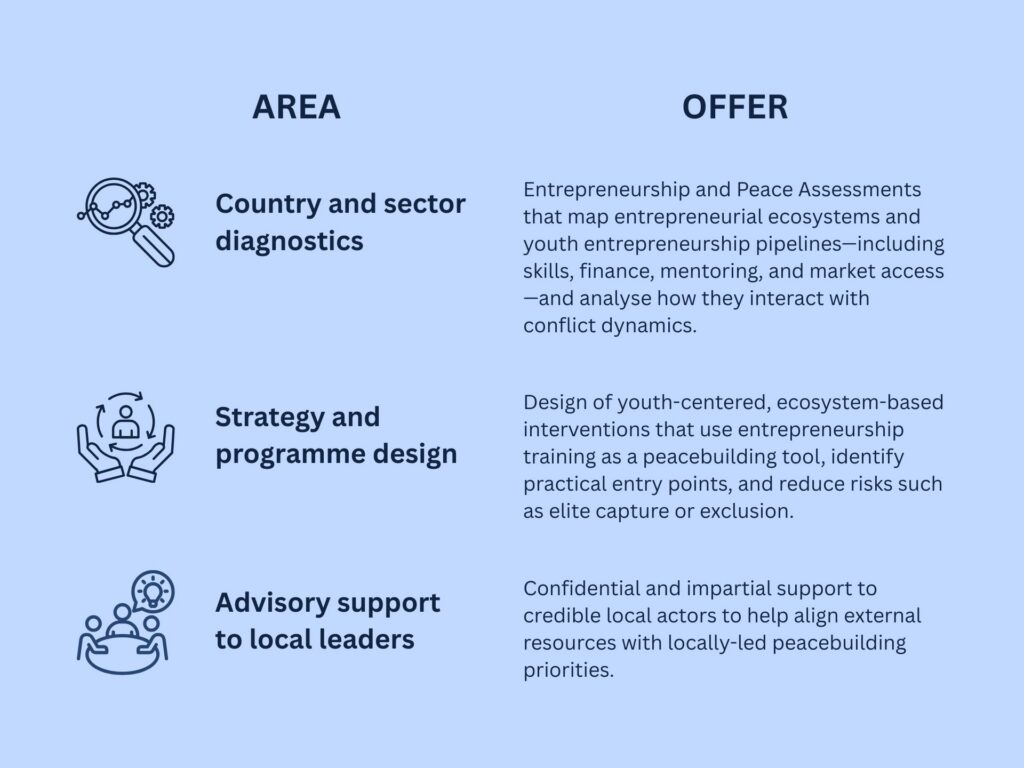
What we offer
Key Resource

Entrepreneurs as Peacebuilders in Fragile States (Kaplan & Magendzo)
This flagship publication provides original analysis and practical guidance on how entrepreneurs—particularly young entrepreneurs—can act as agents of inside-out change in fragile and conflict-affected settings.
FAQ
A bottom-up approach to peacebuilding and stabilization that treats entrepreneurship as a way to strengthen skills, incentives, and local agency in fragile settings.
Because youth exclusion is often a driver of fragility, while youth entrepreneurship can build livelihoods, skills, and constructive forms of participation.
The focus is not only on business creation, but on how entrepreneurial ecosystems can reinforce trust, inclusion, and resilience in transition contexts.