Sarah Nouwen is a Professor of Public International Law at the European University Institute. She is on leave from the University of Cambridge, where she is a Professor in Public International Law and was for many years Co-Deputy Director of the Lauterpacht Centre for International Law and Fellow of Pembroke College. Nouwen is also an Editor-in-Chief of the European Journal of International Law.
Nouwen received a 2-in-1 LLB and LLM from Utrecht University, doing part of her degree at the University of the Western Cape and the University of Cape Town. She then obtained an MPhil in International Relations and a PhD in Law at the University of Cambridge, where she subsequently became a Research Fellow. Prior to assuming her lectureship at Cambridge in 2012, Nouwen worked in international diplomacy: at the Dutch mission to the United Nations, at the Netherlands Embassy in Khartoum, and as a Senior Legal Advisor to the African Union High Level Implementation Panel in Sudan. She also served as a consultant for the UK Department of International Development in Darfur and worked with an NGO in Senegal on microfinance.
She has published extensively on international criminal law, transitional justice and international law more generally. She is the author of Complementarity in the Line of Fire: The Catalysing Effect of the International Criminal Court in Uganda and Sudan (Cambridge University Press, 2013). Her article ‘As You Set out for Ithaka: Practical, Epistemological, Ethical, and Existential Questions about Socio-Legal Empirical Research in Conflict’ won the Leiden Journal prize for the best article published in 2013-2016. Nouwen also received a Philip Leverhulme Prize for her scholarship.
She is currently doing research on international law and peace negotiations, including on the meaning of the term ‘law’ as it is used in literature on law and peace negotiations and on developments in the field of law and peace negotiations. The working title of her new book is Peacemaking: What’s Law Got to Do With It?. She is a member of the Expert Advisory Group of IFIT’s Peace Treaty Initiative.
You may also be interested in

Professor Patrícia Galvão Teles has been member of the United Nations International Law Commission (ILC) since 2017 and Auxiliary Professor of International Law at the
Autonomous University of Lisbon since 2002. She is also a member of the Permanent Court of Arbitration since 2016 and is currently Vice-President of the Portuguese Society for International Law. She is Adjunct Senior Researcher at the Centre for International Law (CIL) of the National University of Singapore and Co-Director of the CIL eAcademy 2020 – Singapore Academy of International Law.
At the International Law Commission, she was General Rapporteur at the 70th Session in 2018 and co-author of the topic on the Long-Term Programme of Work “Sea level rise in relation to International Law.” In 2019, she was appointed Co-chair of the Study Group on “Sea level rise in relation to International Law”.
At the Autonomous University of Lisbon, she teaches currently an undergraduate course on “Public International Law” and Master Courses on “Trends in International Law” and “Just War in International Law”. She has also taught undergraduate and graduate courses, among others, on “Human Rights”, “International Humanitarian Law”, “International Criminal Law” and “EU Law”. She has taught many other subjects at several other Portuguese Universities, Military Institutes and the Diplomatic Academy, and lectures frequently in Portugal and abroad. During the current academic year, she was Visiting Fellow at the Graduate Institute for International and Development Studies in Geneva and Guest Professor at the Catholic University of Lisbon and at ISCTE – University Institute of Lisbon.
She has also been teaching in the International Law Seminar of the ILC in Geneva, in the United Nations Regional Courses in International Law in Addis Ababa, Santiago de Chile and Bangkok and in the International Law Fellowship Programme in The Hague and has lectured in the United Nations Audiovisual Library of International Law. She served as Director of Studies of the English Session during the 2013 Public International Law Summer Session of the Hague Academy of International Law.
Professor Galvão Teles is also Senior Legal Adviser on International Law at the Legal Department of the Portuguese Ministry of Foreign Affairs. Previously, she was Legal Adviser at the Portuguese Permanent Representation to the European Union in Brussels (2008-2015) and Legal Consultant on International Law at the Legal Department of the Portuguese Ministry of Foreign Affairs (2001-2008).
Professor Galvão Teles has published widely in different areas of international law. She is Co-Editor of the Portuguese Yearbook of International Law and a Researcher at Observare (Research Centre for External Relations of the Autonomous University of Lisbon). She is a member of the Committee for the Jean Pictet Competition – Training and Simulations in International Humanitarian Law. She completed her PhD in International Law in 2002 at the Graduate Institute for International and Development Studies in Geneva. She holds a master degree in International Law from the same Institute (1995), after having graduated in Law at the Faculty of Law of the University of Lisbon (1993).
You may also be interested in
-
![]()
post / 21 May 2021
IFIT’s special session on the Peace Treaty Initiative at this year’s Stockholm Forum
-
![IFIT Peace Treaty Initiative]()
post / 11 November 2020
Institute for Integrated Transitions Launches Global Effort to Develop International Treaty on Peace Negotiations
By Mark Freeman – IFIT Executive Director -
![]()
page
Peace Treaty Initiative
Monica McWilliams was a signatory of the 1998 Good Friday Peace Agreement and served as a member of the first Northern Ireland Legislative Assembly.
She was the Chief Commissioner of the Northern Ireland Human Rights Commission from 2005-2012, responsible for delivering the advice on a Bill of Rights for Northern Ireland. She currently serves on the Independent Reporting Commission on the disbandment of paramilitary organisations and was previously the oversight commissioner for prison reform in Northern Ireland. She cofounded the Northern Ireland Women’s Coalition political party, acting as its lead negotiator at the Multi-Party Peace Talks that led to the Good Friday Peace Agreement. She is an Emeritus Professor at Ulster University, and a graduate of Queen’s University, Belfast and the University of Michigan, Ann Arbor.
Her memoir, ‘Stand Up, Speak Out’, was published in 2021. As former Irish prime minister Bertie Ahern wrote at the time: “Monica McWilliams undoubtedly played one of the most pivotal roles in the Northern Ireland peace process.” Monica has worked in a range of war torn societies and published the first longitudinal study on domestic violence during political conflict. She is a joint recipient of the Profile in Courage Award from the John F. Kennedy Library Foundation. In 2023, she was elected a member of the Royal Irish Academy.
You may also be interested in

Miriam Coronel-Ferrer is a full professor at the University of the Philippines, teaching courses and publishing on comparative governments and politics of Southeast Asia, human rights, peace processes, and democratization.
Miriam previously headed the Government of the Philippines panel in the peace talks with the Moro Islamic Liberation Front that culminated in the signing of the Comprehensive Agreement on the Bangsamoro in March 2014. She led governmental negotiations, consultation, and strategizing processes, and was also responsible for setting up the peace infrastructure and supervising the first two years of implementing the accord.
Miriam is also a former member of the UN Standby Team of Senior Mediation Advisers, where she supported UN engagements in the Maldives, Afghanistan, and the ASEAN region.
Miriam has also been extensively involved in national civil society campaigns, co-leading the initiative to draft the National Action Plan on Women, Peace and Security that was adopted by the Philippine government in 2010. In addition, she has been part of international CSO-led human rights/peace missions in Nepal, East Timor, Cambodia, the Philippines, Myanmar, and Sudan.
Miriam was one of the four recipients of the 2023 Ramon Magsaysay Awards for championing inclusivity and women’s participation in peace-building.
You may also be interested in
Mahnoush H. Arsanjani is a leading international lawyer. She served in the United Nations Office of Legal Affairs for over 30 years in various positions. She was Director of the Codification Division and Secretary to the United Nations International Law Commission, and also Secretary of the Committee of the Whole of the Rome Conference on the Establishment of the International Criminal Court. She served as a member of the Bahrain Independent Commission of Enquiry, established in June 2011 by the King of Bahrain to investigate and report on events in Bahrain in 2011. She was a member of the Expert Group established by the 2008 Ad Hoc Energy Ministers Meetings Held in Jeddah and London, and also served as a special consultant to the International Energy Forum which drafted the Charter of the International Energy Forum. She was Vice President of the American Society of International Law and is a member of the Board of Editors of the American Journal of International Law. She is a member of the Institut de Droit International. She has published widely and lectured at leading universities and institutions on international law, international tribunals and international institutions. She is currently a Vice-President of the World Bank Administrative Tribunal.
You may also be interested in
Kathryne Bomberger is the Director-General of the International Commission on Missing Persons (ICMP) and has worked in the field of international relations, human rights, politics and conflict prevention for the last 20 years. Since 1998, she has led the development of ICMP, which is today the world’s leading human rights and rule of law organization dedicated exclusively to helping governments address missing persons issues arising from war, human rights violations, migration, organized crime, natural disasters and other causes. She was appointed ICMP Director-General in 2004.
Since its creation in 1996, ICMP has been transformed from an ad hoc mechanism tasked with assisting countries emerging from the conflicts in the former Yugoslavia to a treaty-based international organization with global reach. Kathryne Bomberger has consistently sought to ensure that the global challenge of missing persons is addressed by governments as an urgent priority, in a manner that is modern, effective and based on the rule of law.
Ms Bomberger has worked in conflict and post-conflict areas as well as in areas affected by disasters and by organized crime (including the Western Balkans, Cyprus, Armenia, Iraq, Libya, Lebanon, Ukraine, Mexico, Colombia, Haiti, and the Philippines), helping governments, courts, prosecutors, NGOs, scientists, academics and others to build capacity to address the cross-cutting issue of missing persons, including through the development of effective institutions and legislation. She has spoken on the issue of missing persons at countless public forums, including the United Nations and the US Congress, and she has been interviewed by the BBC, the Guardian, the New York Times, the Financial Times, the Economist and many other media outlets, as well as participating in TV and film documentaries. Her numerous awards include recognition by the President of France as a Chevalier de la Legion d’Honneur.
Before joining ICMP, Kathryne Bomberger worked for the Organization for Security and Cooperation in Europe, the UN, and the US Senate. She has an undergraduate degree in History and a graduate degree in International Relations, with a focus on Middle East Studies, from the Elliot School of International Relations at the George Washington University in Washington, D.C. She is an American national currently residing in The Hague, the Netherlands.
You may also be interested in
Dr. Issaka Souaré is a senior mediation and governance expert. He previously worked (2016-2021) at the UN Standby Team of Senior Mediation Advisors. In that capacity, he advised the AU Facilitator in the Democratic Republic of Congo (DRC) on the conduct of the national dialogue. In the Central African Republic, he supported strategic reflections of the UN mission (MINUSCA), the African Union and the CAR Government on a dialogue process with non-state armed groups. He provided advice to the Secretary General’s Personal Envoy on Western Sahara, and supported the UN Mission in the Democratic Republic of Congo to the design of a mediation strategy to guide talks with the Patriotic Resistance Front of Ituri (FRPI). He also supported dialogue-related initiatives in Chad, Malawi, Togo, São Tomé and Príncipe, Zambia and Haiti. From 2013-2016 he was Special Adviser to the AU High Representative for Mali and the Sahel, working on the Mali peace processes. Issaka has also served at the AU Commission in policymaking and analysis roles, with a focus on early warning and preventive diplomacy. He speaks Arabic, English and French.
You may also be interested in
-
![]()
page
Peace Treaty Initiative
-
![]()
post / 17 September 2021
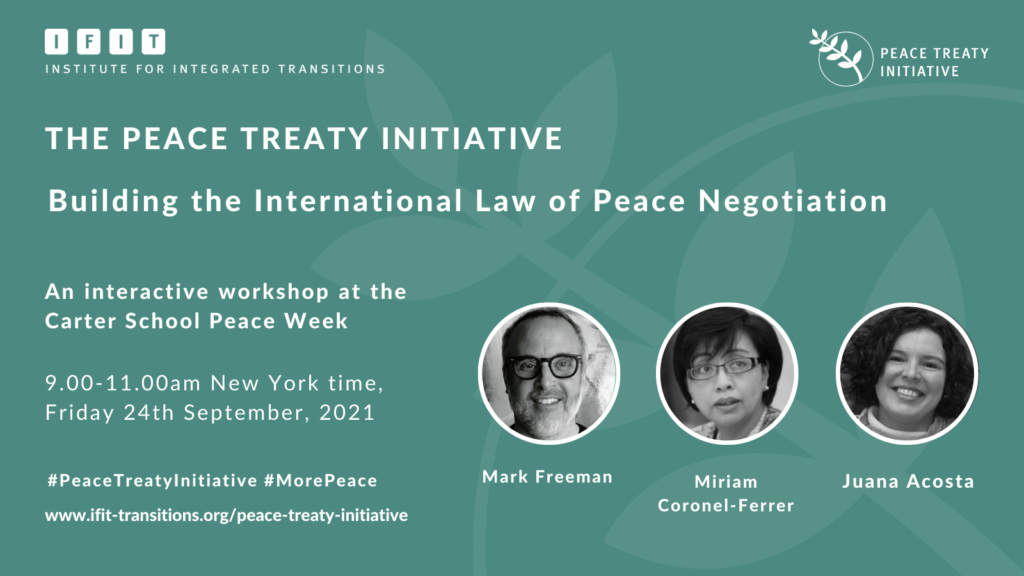
PAST EVENT: Building the International Law of Peace Negotiation – IFIT event at the Carter School Peace Week
-
![IFIT Peace Treaty Initiative]()
post / 11 November 2020
Institute for Integrated Transitions Launches Global Effort to Develop International Treaty on Peace Negotiations
By Mark Freeman – IFIT Executive Director
Hyeran Jo is Associate Professor at the Department of Political Science at Texas A&M University in U.S.A. She studies international institutions, international law, and civil conflicts. Her book, Compliant Rebels: Rebel Groups and International Law in World Politics (Cambridge University Press, 2015), won the Chadwick Alger Prize in 2016, the best book in the field of international organization, awarded by the International Studies Association. Her work can also be found in journals such as International Organization, Journal of Conflict Resolution, British Journal of Political Science, Journal of Peace Research, and Law and Contemporary Problems. Her research has been supported by the U.S. National Science Foundation, Buffett Foundation, and Alexander von Humboldt Stiftung.
You may also be interested in
Ambassador Hesham Youssef is a Senior Advisor at the European Institute of Peace, having previously served as a Senior Fellow and Advisor at the United States Institute of Peace from 2019 to April 2025. A career diplomat with Egypt’s Ministry of Foreign Affairs, Youssef has extensive experience in regional diplomacy and conflict resolution.
From 2014 to 2019, he served as Assistant Secretary General for Humanitarian, Cultural and Social Affairs of the Organisation of Islamic Cooperation (OIC). Prior to this, Youssef held senior positions at the Arab League from 2001 to 2014, serving as Official Spokesman and later Chief of Staff to Secretary General Amr Moussa from 2003 to 2011. From 2012 to 2014, he was Senior Advisor to Secretary General of the Arab League, Dr Nabil Elaraby, on crisis management and Arab League reform.
Youssef has worked extensively on conflict resolution in the Middle East, particularly the Arab-Israeli conflict, reconciliation in Iraq, and other regional conflicts. He has authored several papers on conflicts and developments in the Middle East. He is an advisor to the IFIT Peace Treaty Initiative.
You may also be interested in
Mr. Diego García-Sayán has served as UN Special Rapporteur on the independence of judges and lawyers since December 2016. Mr. García-Sayán was a judge of the Inter-American Court of Human Rights for two consecutive terms. During his tenure, he was elected Vice-President of the Court (2008-2009) and President of the Court for two consecutive terms (2009-2013).
Mr. García-Sayán has broad experience working for multilateral organizations such as the United Nations and the Organization of American States. Previous responsibilities include: representative of the UN Secretary-General for the Peace Agreements at El Salvador and for the subsequent verification of the agreements, reporting directly to the Security Council; member and Chairperson of the UN Working Group on Enforced or Involuntary Disappearances; member of the Redesign Panel on the United Nations System of Administration of Justice, appointed by the UN Secretary-General in 2006; Head of the Electoral Mission of the Organization of American States (OAS) in Guatemala during the general elections (2007).
Mr. García-Sayán was Minister of Justice during the democratic transition in Peru and Minister of Foreign Affairs. He was also President of the High Level Commission to design and implement the Museum of Memory, Tolerance and Social Inclusion in Peru, inaugurated in December 2015. Mr. García-Sayán is the author of several books on international law and development.