
Publication
/ Polarization
Aug 2025
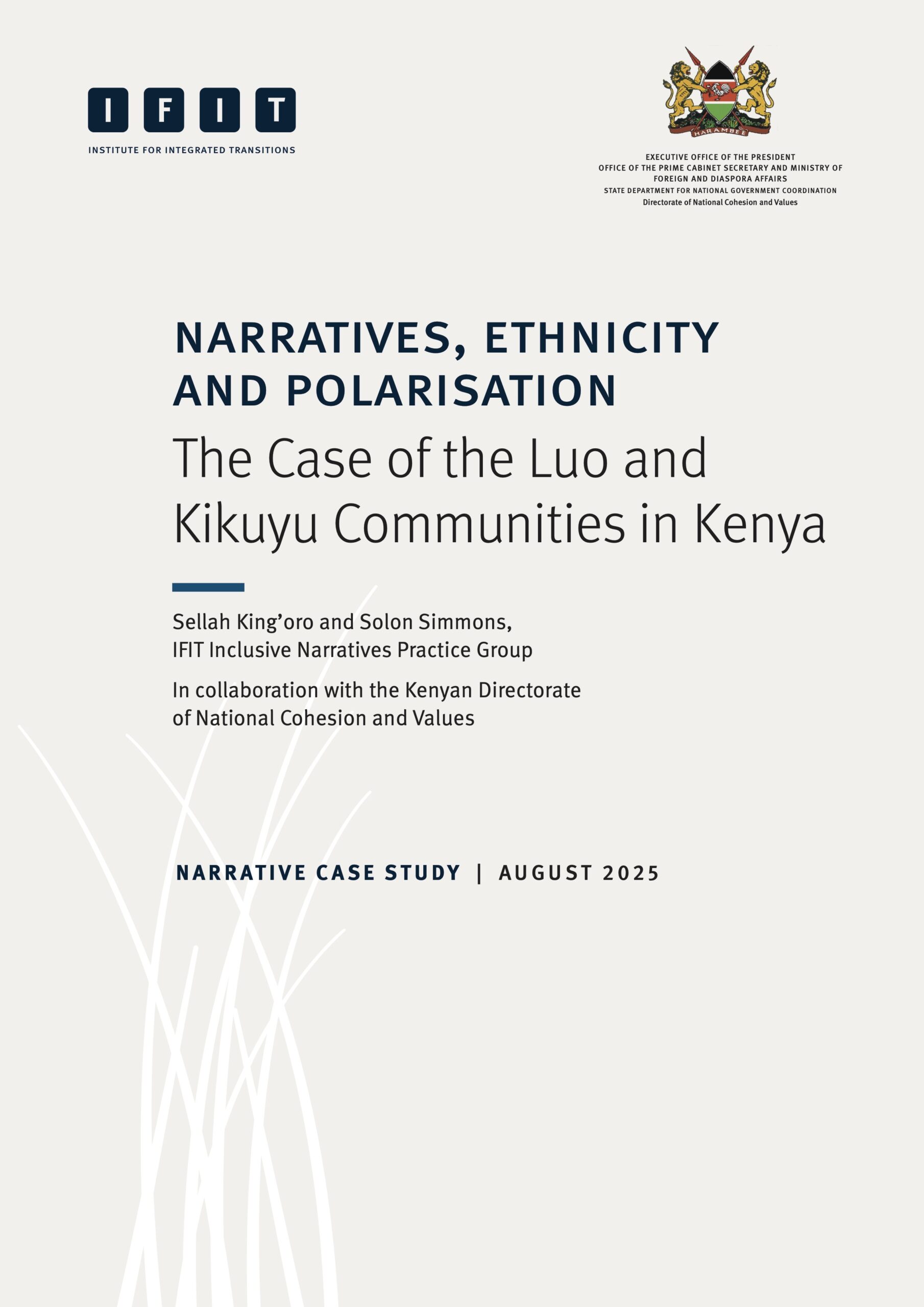
Narratives, Ethnicity and Polarisation: The Case of the Luo and Kikuyu Communities in Kenya
This publication, led by IFIT experts in collaboration with the Kenyan Directorate of National Cohesion and Values, is a case study examining the narratives shaping the fraught relationship between the Luo and Kikuyu ethnic communities in Kenya – a rivalry that has long been a substantial barrier to national cohesion. Based on an in-depth assessment, the case study presents key narratives that shape Luo–Kikuyu relations and their implications for broader dynamics in Kenya. The findings reveal that traditional peacebuilding and depolarisation strategies, which tend to promote a new unifying narrative, have not been effective in the face of entrenched ethnic identities. Instead, a novel narrative peacebuilding approach is required – one which emphasises understanding the historical events, myths, collective traumas and structural dynamics at the root of divisive narratives and engaging with communities to reshape those narratives in a way that enables peaceful engagement and shared responsibility for addressing underlying socio-political issues.
Narratives are more than just words. They serve as frameworks through which individuals and groups interpret their experiences and decide on their social and political actions, often playing a direct role in either escalating or alleviating tensions in polarised societies. The analysis underscores how group identities and interpretations of the colonial and postcolonial past inform current perceptions in Kenya, leading to cycles of mistrust and conflict, particularly during election periods. Through a detailed mapping of the simple, self-perpetuating narratives that validate one group’s grievances while casting others as villains – as well as the role of influential actors and the media in driving them – this research illuminates the necessity of dealing with narratives, rather than leaving them to fester, in any effort to promote national unity and mitigate ethnic polarisation. The study concludes with practical recommendations for narrative assessments and interventions aimed at promoting greater understanding and cooperation among Kenya’s diverse ethnic groups and beyond.
The DOI registration ID for this publication is: https://doi.org/10.5281/zenodo.16939393.
You may also be interested in
-
![]()
publication /
Polarization
Polarisation: The ‘Hyper-Problem’ Transitional Justice Can No Longer Ignore
-
![]()
publication /
Global Initiative on Polarization
Ten Ideas on How to Overcome Polarization
Available in:
-
Français
-
Deutsch
-
Español
-
العربية
-
![]()
publication /
Global Initiative on Polarization
First Principles: The Need for Greater Consensus on the Fundamentals of Polarisation
Available in:
-
Español
-
Français
-
العربية
-
Português
-
русский
-
فارسی
-
中文
-
Kiswahili
-
हिंदी
-
Bahasa
-
Hausa
-
اُردُو
-
![]()
publication /
Inclusive Narratives
Narrative, Power and Polarisation: The Role of Influential Actors
Available in:
-
Español
This publication, led by IFIT experts in collaboration with the Kenyan Directorate of National Cohesion and Values, is a case study examining the narratives shaping the fraught relationship between the Luo and Kikuyu ethnic communities in Kenya – a rivalry that has long been a substantial barrier to national cohesion. Based on an in-depth assessment, the case study presents key narratives that shape Luo–Kikuyu relations and their implications for broader dynamics in Kenya. The findings reveal that traditional peacebuilding and depolarisation strategies, which tend to promote a new unifying narrative, have not been effective in the face of entrenched ethnic identities. Instead, a novel narrative peacebuilding approach is required – one which emphasises understanding the historical events, myths, collective traumas and structural dynamics at the root of divisive narratives and engaging with communities to reshape those narratives in a way that enables peaceful engagement and shared responsibility for addressing underlying socio-political issues.
Narratives are more than just words. They serve as frameworks through which individuals and groups interpret their experiences and decide on their social and political actions, often playing a direct role in either escalating or alleviating tensions in polarised societies. The analysis underscores how group identities and interpretations of the colonial and postcolonial past inform current perceptions in Kenya, leading to cycles of mistrust and conflict, particularly during election periods. Through a detailed mapping of the simple, self-perpetuating narratives that validate one group’s grievances while casting others as villains – as well as the role of influential actors and the media in driving them – this research illuminates the necessity of dealing with narratives, rather than leaving them to fester, in any effort to promote national unity and mitigate ethnic polarisation. The study concludes with practical recommendations for narrative assessments and interventions aimed at promoting greater understanding and cooperation among Kenya’s diverse ethnic groups and beyond.
The DOI registration ID for this publication is: https://doi.org/10.5281/zenodo.16939393.
You may also be interested in
-
![]()
publication / Polarization
Polarisation: The ‘Hyper-Problem’ Transitional Justice Can No Longer Ignore
-
![]()
publication / Global Initiative on Polarization
Ten Ideas on How to Overcome Polarization
Available in:- Français
- Deutsch
- Español
- العربية
-
![]()
publication / Global Initiative on Polarization
First Principles: The Need for Greater Consensus on the Fundamentals of Polarisation
Available in:- Español
- Français
- العربية
- Português
- русский
- فارسی
- 中文
- Kiswahili
- हिंदी
- Bahasa
- Hausa
- اُردُو
-
![]()
publication / Inclusive Narratives
Narrative, Power and Polarisation: The Role of Influential Actors
Available in:- Español