Public Commentary / 03 June 2026
Governing for the Enemy
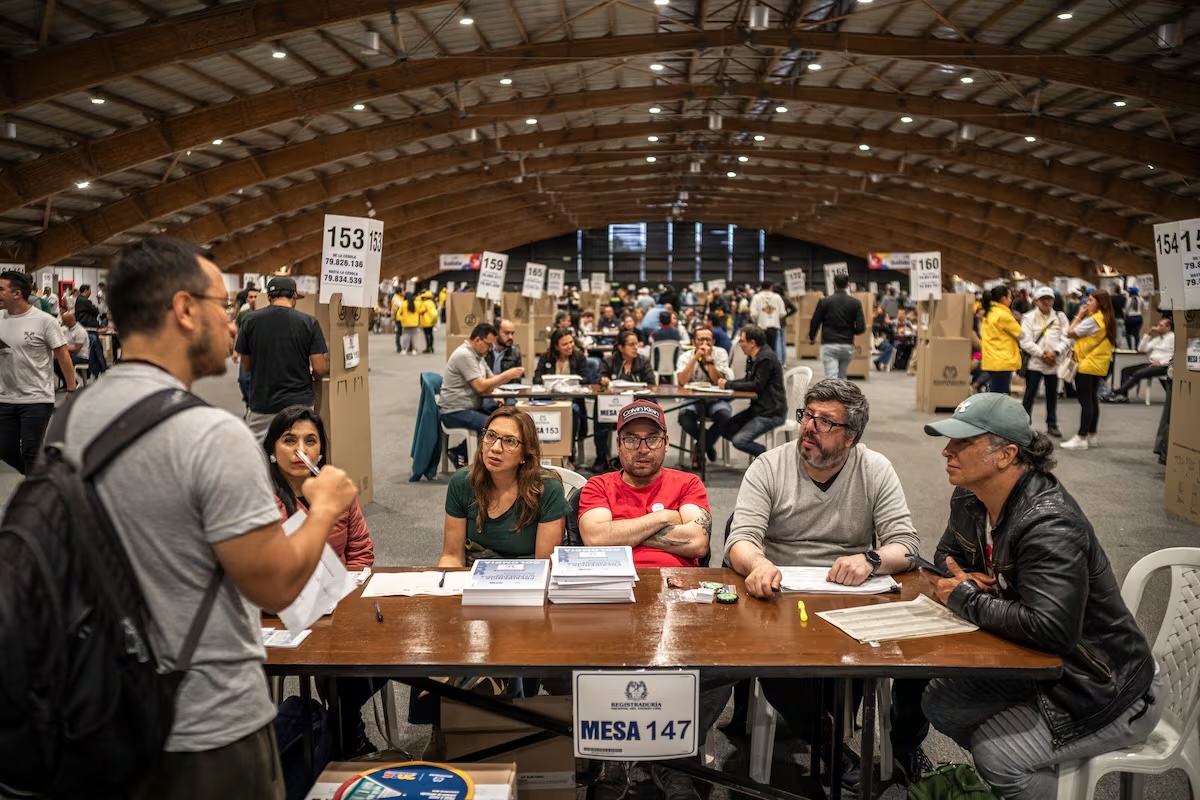
The question is not whether it will be Iván Cepeda or Abelardo de la Espriella who wins the
second round on June 21, but how the winner can govern for all of Colombia.
“We are going to defeat the enemies of the Republic,” or we will eliminate the left, Abelardo de la Espriella has said on various occasions — a message he repeated forcefully in his victory speech on Sunday. From Iván Cepeda, the message is not very different: “Uribismo is fascist. It represents the ideology of contempt in all its forms — racism, classism, misogyny, homophobia, the destruction of nature, hatred of peace.”
In both cases, these messages have been delivered before crowds of tens of thousands, broadcast on national television, and have accumulated hundreds of thousands of views on social media. The message is clear: either we win, or they destroy us.
This is a manifestation of the most negative version of polarisation — one that intensifies during electoral periods but is not resolved once the presidential race is decided. There are interesting examples from Chile, which I discuss below, but above all, Colombia has the opportunity to manage its differences far better than the denial and zero-sum logic that recent campaign rhetoric has left in the air.
When elections are seen as all-or-nothing, as political survival or death, they leave deep fractures at the social, family, and community level. Their effects extend to governability: “We will defend democracy by reason or by force,” “they will not pass — the far-right projects,” said De la Espriella and Cepeda respectively, before their crowds last night.
Turning a political rival or adversary into an enemy has proven to be a powerful mobilising tool in a campaign where the fight for attention is fierce and emotions are everything. The formula we have seen repeated across the region in recent years has found fertile ground in Colombia. But as we have also seen, the argument that wins votes quickly becomes a major obstacle to governing.
Neither Cepeda’s vision of governability through the inclusion of those historically excluded, nor De la Espriella’s vision based on authority and order, can be built without some level of shared legitimacy among sectors that currently perceive each other as threats. Casting the other as an enemy — democracy defined by destroying the other — and the opportunistic use of power — the sense that it is now or never — only encourages the opposing side to spend four years sabotaging every governing effort and waiting for their turn, or their revenge.
Some degree of acceptance of the rules of the game is what allows authorities to formulate and implement policies, to have their decisions accepted, to channel conflicts through institutions rather than through force, to prevent violence, and to build political and social agreements. This should matter to everyone seeking the presidency. After all, the Constitution mandates that the President represent national unity — democratic coexistence and shared legitimacy — and guarantee the rights and freedoms of all.
Our system is not designed to function without this. Neither imposition — governing by decree, for example — nor protest — demanding change from the streets — produces outcomes or policies with enough stability to function even in the medium term, let alone with any promise of long-term transformation.
If the conversation, the debate, and the attacks from both sides do not change in the coming days, any declaration of unity, dialogue, or agreement from whoever wins the election will most likely ring hollow — or promise to plant seeds in already barren ground.
The presidents of recent decades in Colombia — from Belisario Betancur to Gustavo Petro — have all opened their terms by pledging to govern for everyone, to hold dialogues, make pacts, foster national conversations, and pursue reconciliation. From these declarations have emerged peace processes, national dialogue initiatives, and efforts at encounter. Some more successful than others, but all facing the great challenge of including the part of the country that sees itself represented in the political adversary and was left out of the initial picture.
When mobilisation is driven by dehumanisation, stigmatisation, rejection, or hatred of a political sector and a segment of the population — on both sides — rebuilding trust becomes extremely difficult. What lingers most is suspicion, blame, recrimination, and resentment.
Although Latin America is full of polarising rhetoric, it also has examples of leaders who understood that governing for everyone requires more than an appeal to unity. Patricio Aylwin, Chile’s first president after Pinochet’s dictatorship, chose to rebuild a fractured political community through truth, reparation, and agreement. In his case, inclusive governability did not come from eliminating differences, but from creating conditions to coexist with them. Gabriel Boric, in contrast, came to power through social mobilisation and amid one of the deepest moments of institutional questioning. Yet after the failure of the first constitutional process, he insisted on speaking of Chileans as compatriots rather than adversaries, shifting part of his discourse toward defending institutions and the need to build agreements. There is a difference between arriving in power representing one part of the country and actually governing for the nation as a whole.
At IFIT (the Institute for Integrated Transitions), we have been bringing together leaders from across the ideological spectrum in our Depolarising Circles to test just how true it is that we are two opposing sides, that we are radically different, that we face a zero-sum scenario — and how homogeneous each of those sides actually is internally. The results of this exercise will be turned into concrete ideas about what inclusive governability could look like for Colombia in 2026.
In the meantime, we have been genuinely surprised by the complexity and richness of the ideas at play around how to solve our country’s problems, the diversity that exists within each “camp,” how deep the points of common ground run, and how different people are when given the opportunity to engage with our differences without threat or stigma. We have also seen that those differences represent a diversity that, when well channelled, is not a problem but a source of strength.
For now, and over the next three weeks, as part of this electoral process, we have not only the right and responsibility to vote, but also the responsibility to demand that our candidates show that it is possible to debate with ideas — that we do not want to be further divided, that we are tired of conflict, and that we are aware of how vulnerable we are to violence.
If it is true, as La Silla Vacía noted yesterday, that we face “two mutually exclusive projects,” we need now more than ever to remind them that it is one Colombia.
Irene Vallejo calls on us to challenge the “mirage of apparent unanimity” — the tendency to turn those on the other side into a homogeneous and threatening group. Few things are as useful to conflict as convincing ourselves that those on the other side are exactly alike among themselves and exactly different from us. But a democracy does not function because differences disappear. It functions because there is a willingness to recognise that behind every label, every vote, and every political identity, there are people with motivations, fears, interests, and contradictions as complex as our own. And it is on that complexity — not on unanimity — that any possibility of governing for everyone ultimately rests, including that “enemy.”
Originally published in El País.